PCHR Killings
B'Tselem Fatalities
A Brutal Routine
Science of Suicide Bombing
Settler Violence
1st Month: 28 boys, 140
08/01/2003 - 09/01/2003
10/01/2003 - 11/01/2003
11/01/2003 - 12/01/2003
12/01/2003 - 01/01/2004
01/01/2004 - 02/01/2004
02/01/2004 - 03/01/2004
03/01/2004 - 04/01/2004
04/01/2004 - 05/01/2004
05/01/2004 - 06/01/2004
06/01/2004 - 07/01/2004
08/01/2004 - 09/01/2004
09/01/2004 - 10/01/2004
10/01/2004 - 11/01/2004
11/01/2004 - 12/01/2004
12/01/2004 - 01/01/2005
01/01/2005 - 02/01/2005
02/01/2005 - 03/01/2005
03/01/2005 - 04/01/2005
04/01/2005 - 05/01/2005
06/01/2005 - 07/01/2005
07/01/2005 - 08/01/2005
08/01/2005 - 09/01/2005
11/01/2005 - 12/01/2005
12/01/2005 - 01/01/2006
01/01/2006 - 02/01/2006
02/01/2006 - 03/01/2006
03/01/2006 - 04/01/2006
04/01/2006 - 05/01/2006
05/01/2006 - 06/01/2006
06/01/2006 - 07/01/2006
07/01/2006 - 08/01/2006
08/01/2006 - 09/01/2006
09/01/2006 - 10/01/2006
10/01/2006 - 11/01/2006
11/01/2006 - 12/01/2006
04/01/2007 - 05/01/2007
05/01/2007 - 06/01/2007
09/01/2007 - 10/01/2007
01/01/2009 - 02/01/2009
02/01/2009 - 03/01/2009
03/01/2009 - 04/01/2009
10/01/2009 - 11/01/2009
11/01/2009 - 12/01/2009
12/01/2009 - 01/01/2010
01/01/2010 - 02/01/2010
02/01/2010 - 03/01/2010
03/01/2010 - 04/01/2010

Israel and Palestine
Human Rights Watch reveals extent of Israel's phosphorus use in Gaza | World news | guardian.co.uk
Human Rights Watch report claims Israel committed war crimes in its use of air-burst white phosphorus artillery shells
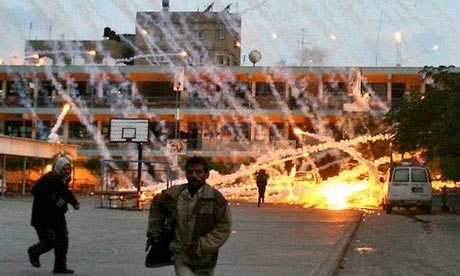
Palestinian civilians and medics run to safety during an Israeli strike using phosphorus shells at a UN school. Photograph: Mohammed Abed/AFP
Israel's military fired white phosphorus over crowded areas of Gaza repeatedly and indiscriminately in its three-week war, killing and injuring civilians and committing war crimes, Human Rights Watch said today.
In a 71-page report, the rights group said the repeated use of air-burst white phosphorus artillery shells in populated areas of Gaza was not incidental or accidental, but revealed "a pattern or policy of conduct".
It said the Israeli military used white phosphorus in a "deliberate or reckless" way. The report says:
• Israel was aware of the dangers of white phosphorus.
• It chose not to use alternative and less dangerous smoke shells.
• In one case, Israel even ignored repeated warnings from UN staff before hitting the main UN compound in Gaza with white phosphorus shells on 15 January.
"In Gaza, the Israeli military didn't just use white phosphorus in open areas as a screen for its troops," said Fred Abrahams, a senior Human Rights Watch researcher. "It fired white phosphorus repeatedly over densely populated areas, even when its troops weren't in the area and safe smoke shells were available. As a result, civilians needlessly suffered and died." ......
Most of the Israeli military's white phosphorus in Gaza was fired in 155mm artillery shells, each containing 116 wedges soaked with the chemical.
In January, the Guardian found one such shell still smoking several days after it was fired, outside the home of the Abu Halima family in Atatra. One white phosphorous shell hit the house directly, killing a father and four of his children. His wife was severely burnt. Human Rights Watch also reported the same case.
Human Rights Watch found 24 spent white phosphorus shells in Gaza, all from the same batch made in a US ammunition factory in 1989 by Thiokol Aerospace. Other shells were photographed during the war with markings showing they were made in the Pine Bluff Arsenal, also in America, in 1991. ...
Press TV - UN: Israel broke six-month truce in Gaza
A new UN report exposes a bit of misinformation peddled by the US and Israel and shatters the Zionist illusion that the Gaza war was legal.
The report, prepared by human rights investigator Richard Falk, confirms that Tel Aviv was indeed the party that violated the Egyptian-brokered six-month truce in Gaza.
...
"Records show that, during the ceasefire, it was predominantly Israel that resorted to conduct inconsistent with the undertaking, and Hamas that retaliated," Falk responded in a report presented Monday at the Geneva-based UN Human Rights Council.
...
"On 4 November … Israel killed a Palestinian in Gaza, mortars were fired from Gaza in retaliation, and then an Israeli air strike was launched that killed an additional six Palestinians in Gaza," Falk said, adding that the "the breakdown of the ceasefire seems to have been mainly a result of Israeli violations."
Falk, who based his findings on Israeli sources, said the number of Palestinian rockets and mortar shells fired into Israel after the ceasefire came into effect in June had considerably declined.
"The ceasefire was remarkably effective; after it began in June 2008, the rate of rocket and mortar fire from Gaza dropped to almost zero, and stayed there for almost four months," the report continued. ...
U.N. report condemns Israel for Gaza operation - CNN.com
(CNN) -- Israeli soldiers routinely and intentionally put children in harm's way during their 22-day offensive against the Palestinians in Gaza, according to a United Nations report made public Monday.
The report said a working group had documented and verified reports of violations "too numerous to list."
For example, on January 15, in a town southwest of Gaza City, Israel Defense Forces soldiers ordered an 11-year-old boy to open Palestinians' packages, presumably so that the soldiers would not be hurt if they turned out to contain explosives, the 43-page report said.
They then forced the boy to walk in front of them in the town, it said. When the soldiers came under fire, "the boy remained in front of the group," the report said.
...
The U.N. report called the response by Israel disproportionate.
Of the 1,453 people estimated killed in the conflict, 1,440 were Palestinian, including 431 children and 114 women, the report said.
The 13 Israelis killed included three civilians and six soldiers killed by Hamas, and four soldiers killed by friendly fire, it said. ...
Israel’s war crimes - Le Monde diplomatique - English edition
For the first time since the establishment of Israel in 1948 the government is facing serious allegations of war crimes from respected public figures throughout the world. Even the secretary general of the United Nations, Ban Ki-moon, normally so cautious about offending sovereign states – especially those aligned with its most influential member, the United States – has joined the call for an investigation and potential accountability. To grasp the significance of these developments it is necessary to explain what made the 22 days of attacks in Gaza stand shockingly apart from the many prior recourses to force by Israel to uphold its security and strategic interests.
...
In other words, there were no grounds for claiming the right of self-defence as Israel was not the object of a Hamas attack, and diplomatic alternatives to force existed and seemed credible, and their good-faith reliance was legally obligatory. On this basis the focus of legal debate should not be upon whether Israeli force was disproportionate. Of course it was. The focus should be on whether the Israeli attacks were a prohibited, non-defensive use of force under the UN charter, amounting to an act of aggression, and as such constituting a crime against peace. At Nuremberg after the second world war, surviving Nazi leaders were charged with this crime, which was described in the judgment as “the supreme crime” encompassing the others.
The Gaza form of encounter almost by necessity blurs the line between war and crime, and when it occurs in a confined, densely populated area such as Gaza, necessarily intermingles the resistance fighters with the civilian population. It also induces the resistance effort to rely on criminal targeting of civilians as it has no military capacity directly to oppose state violence. In this respect, the Israeli attacks on Gaza and the Hamas resistance crossed the line between lawful combat and war crimes.
These two sides should not be viewed as equally responsible for the recent events. Israel initiated the Gaza campaign without adequate legal foundation or just cause, and was responsible for causing the overwhelming proportion of devastation and the entirety of civilian suffering. Israeli reliance on a military approach to defeat or punish Gaza was intrinsically “criminal”, and as such demonstrative of both violations of the law of war and the commission of crimes against humanity.
There is another element that strengthens the allegation of aggression. The population of Gaza had been subjected to a punitive blockade for 18 months when Israel launched its attacks. This blockade was widely, and correctly, viewed as collective punishment in a form that violated Articles 33 and 55 of the Fourth Geneva Convention governing the conduct of an occupying power in relation to the civilian population living under occupation. This policy was itself condemned as a crime against humanity, as well as a grave breach of international humanitarian law.
It also had resulted in serious nutritional deficiencies and widespread mental disorders on the part of the entire Gaza population, leaving it particularly vulnerable to the sort of “shock and awe” attack mounted by Israel from land, air and sea. This vulnerability was reinforced by Israel’s unwillingness to allow Gaza civilians to seek safety while the tiny Strip was under such intense combat pressure. Two hundred non-Palestinian wives were allowed to leave, which underscored the criminality of locking children, women, the sick, elderly and disabled into the war zone, and showed its ethnically discriminatory character. This appears to be the first time in wartime conditions that a civilian population was denied the possibility of becoming refugees. ...
